
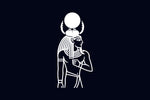
The Scarab God: How Ancient Egypt Showed Khepri in Art
5 min reading time
5 min reading time
I've always found it odd how one small beetle changed everything for ancient Egypt. The scarab beetle pushed dung balls across the sand. Simple, right? But somewhere along the way, someone watched this happen and saw the sun rolling across the sky. That single thought created one of Egypt's most loved gods.
Khepri became the god of morning, rebirth, and new starts. Artists painted him, carved him, and shaped him for thousands of years. Let me show you how they did it.
Walk into any museum with Egyptian art. You'll spot Khepri fast. He's the guy with a scarab beetle for a head.
Most gods got animal heads in Egyptian art. Horus had a falcon. Anubis had a jackal. Khepri? He wore the whole scarab beetle as his head. The shell sat where a human head should be. Dark, shiny, round. Sometimes the legs stuck out too.
Artists painted him in tomb walls this way. They carved him into temple stones. The beetle head became his trademark. You couldn't mistake him for anyone else.
But here's what gets me. Sometimes they showed just the beetle. No human body at all. Just a scarab doing its thing, pushing the sun disk. The meaning stayed the same. The form changed based on what the artist wanted to say.
This image shows up everywhere. A scarab beetle pushes a red or gold circle. That circle is the sun.
Ancient Egyptians believed Khepri pushed the sun from east to west each day. Like the dung beetle pushed its ball. The comparison made sense to them. It made the sunrise feel personal, active, alive.
Painters loved this scene. They put it in tombs to promise rebirth. They added it to papyrus scrolls about the afterlife. The beetle worked hard in these images. You could almost see the effort.
Temple walls showed it too. Giant versions carved in stone. The scarab might be tiny in real life, but in art? They made him huge. Powerful. Worth your respect.
Some images added wings to the beetle. Spread wide, detailed with feathers. This turned Khepri into something more than a bug. He became divine, capable of flight, able to lift the sun itself.
Egypt went wild for scarab amulets. I mean wild.
These small carved stones looked like beetles from above. Flat on the bottom, rounded on top. Artists made them from every material they could find. Green stone, blue stone, gold, clay, even glass.
People wore them as rings. They strung them on necklaces. They tucked them into mummy wrappings. The bottom part often had writing or symbols carved in. Names, wishes, prayers, magic words.
These amulets meant protection and rebirth. If Khepri could push the sun up each morning, he could push your life forward too. He could bring you back from death.
The quantity is what surprises me. Thousands still exist in museums. Thousands more probably sat in tombs that got robbed. Every person in Egypt seemed to want one. Rich or poor, old or young. The scarab beetle became the most popular good luck charm in history.
This gets darker. And more beautiful.
When someone died, embalmers sometimes placed a special scarab over their heart. These heart scarabs were bigger than the regular amulets. They came with a specific spell from the Book of the Dead.
The spell basically said: "Heart, don't testify against me when I get judged in the afterlife."
Artists carved this spell right on the bottom of the beetle. They made these scarabs with care, knowing they'd stay hidden in wrappings for eternity. The craftsmanship still shocks me. All that work for something no living person would see again.
The wings often appeared here too. Heart scarabs frequently showed spread wings on the sides. This connected Khepri to protection, to the soul's journey, to hope for what comes next.
Egyptian artists didn't pick colors randomly. Each shade carried meaning.
Khepri usually appeared in black, green, or blue. Black matched the real beetle's color. But it also meant fertile soil, rebirth, the rich earth after the Nile flooded.
Green showed growth and new life. The color of plants pushing through dirt. The color of things that refuse to stay dead.
Blue connected to the sky and water. To the heavens where gods lived. To the Nile that gave Egypt everything.
Gold showed up when artists wanted to emphasize his divine nature. The sun god needed sun colors sometimes. That made sense.
These color choices weren't accidents. Every artist knew the rules. They followed them because the colors themselves held power.
Artists often grouped Khepri with Ra and Atum. These three formed a sort of sun god trio.
Ra ruled the noon sun at its strongest. Atum handled the evening sun, old and setting. Khepri took morning duty. Young, fresh, full of potential.
Some images showed all three in one scene. The sun's journey from dawn to dusk, all captured in a single artwork. Khepri might be on the left, beetle head proud, ready to start the day.
Other times, they combined the three into one being. A god with three forms, three names, three moments. The beetle head appeared as one aspect of this merged divine figure.
This flexibility in showing Khepri tells me something. Egyptian art wasn't rigid. Artists found ways to express complex ideas about time, divinity, and nature's cycles. They made it work visually.
I think about Khepri when I see beetles now. Any beetle, really.
Ancient Egyptian artists took something small and common. They saw meaning in it. They created thousands of images, amulets, carvings, and paintings. They made the scarab beetle sacred.
That act of seeing? That choice to find the divine in the everyday? It changed art history.
Museums worldwide display these pieces now. The scarab images survived millennia. They still communicate across time. You don't need to read hieroglyphs to understand that a beetle pushing the sun means hope. New beginnings. The promise that tomorrow comes.
Egyptian iconography gave us one of the most lasting symbols ever created. The scarab beetle means rebirth in jewelry, tattoos, and art today. All because ancient artists watched beetles in the sand and imagined something greater.
That's the power of art. That's Khepri's real gift.


$30.00


$44.99 - $49.99


$24.99 - $29.99


$44.99 - $47.46