
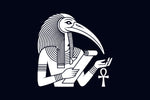
The Egyptian God Thoth in Art and Iconography
5 min reading time
5 min reading time
I've spent years looking at ancient Egyptian art. And honestly? Thoth might be the most interesting god to spot in temples and tombs.
You can always tell it's him. He shows up with an ibis head perched on human shoulders. Sometimes he appears as a full ibis bird. Other times he's a baboon sitting in the morning sun.
The ancient Egyptians loved this god. They painted him everywhere.
The ibis was a sacred bird in Egypt. It had a long, curved beak. The Egyptians watched these birds hunt along the Nile. They saw something special in them.
That curved beak looked like the crescent moon. Thoth was a moon god. See the connection?
Artists painted his head white or black. Both colors meant something. White showed purity and wisdom. Black linked him to the night sky and hidden knowledge.
I find it amazing how one simple choice tells us so much.
Here's where it gets interesting. Thoth also appeared as a baboon. Not just any baboon though.
Egyptian artists showed him as a dog-faced baboon. These animals made loud calls at dawn. The Egyptians thought they were greeting the sun god Ra.
So Thoth became a baboon too. He sat on his haunches with perfect posture. His hands rested on his knees. Artists carved him this way in temples across Egypt.
You can still see these statues today. They look calm and wise. Like they're waiting to share secrets.
Thoth never shows up empty-handed in art. He carries specific items. Each one tells part of his story.
The writing palette appears most often. It's a long, thin board with paint wells. A reed pen rests across it. This marks him as the god of writing and knowledge.
He also holds an ankh. That's the symbol for life. Sometimes he carries a palm branch too. The palm meant years and time.
Think about it. Writing, life, and time. All connected to one god.
Walk into any major Egyptian temple. You'll find Thoth in the reliefs. He appears in specific moments.
One scene shows up again and again. Thoth stands before a pharaoh. He writes the king's name on a sacred tree. This tree recorded the names of all rulers. Being written there meant the gods accepted your rule.
Another common scene shows judgment day. The dead person's heart sits on a scale. Thoth stands ready with his palette. He records the result. Your fate depends on what he writes.
I get chills thinking about it. One god. One record. Your whole afterlife hanging in the balance.
Egyptian artists didn't pick colors randomly. Every shade had meaning.
Thoth often appears in white. Clean, bright white. This showed his role as a pure source of wisdom.
But sometimes artists used blue or green. These colors connected him to the sky and to creation itself.
His ibis beak usually showed up in yellow or gold. That linked him to the sun and divine power.
The backgrounds mattered too. Dark blues and blacks put him in the night realm. That's where he measured time and tracked the moon.
Look closely at Thoth scenes. You'll spot other symbols nearby.
The crescent moon appears often. So does the full moon disk. These sit on his head like a crown.
Stars scatter around him in many paintings. They remind viewers that he measured the heavens.
Writing tools cluster near his feet. Papyrus scrolls. Reed pens. Paint palettes. Stone tablets.
One symbol really stands out though. The Eye of Horus. Stories say Thoth healed this eye after it was damaged in battle. So the eye appears in his scenes as proof of his healing power.
Egypt existed for thousands of years. Art changed during that time.
Early kingdom artists kept Thoth simple. Clean lines. Basic shapes. He looked formal and distant.
Middle kingdom artists added more detail. His feathers got individual lines. His face showed expression. He started feeling more real.
New kingdom art went bold. Bright colors everywhere. Gold leaf covering surfaces. Thoth looked powerful and rich.
But the basic forms stayed the same. Ibis head. Baboon body. Writing tools. Moon symbols.
That consistency tells us something. His identity never wavered. He remained the god of wisdom and writing through every dynasty.
I've looked at thousands of Egyptian images. Thoth still catches my attention every time.
Maybe it's because he represents something we still value. Knowledge. Writing. Truth. Recording what matters.
The ancient artists knew how to show these ideas. They didn't need words. Just an ibis head and a palette.
That's the power of good art. It speaks across thousands of years. It makes you feel connected to people you'll never meet.
You don't need to visit Egypt to see Thoth art. Major museums worldwide display pieces.
The British Museum has amazing examples. So does the Metropolitan Museum in New York. The Cairo Museum obviously holds treasures.
But here's my advice. Look for the small pieces too. Not just the giant temple walls.
Amulets show Thoth in miniature. People wore these for protection and wisdom. They're beautiful and personal.
Papyrus illustrations reveal his story in detail. The Book of the Dead contains stunning Thoth scenes.
Even tomb paintings of regular people sometimes include him. He was that important. That beloved.
Ancient Egyptian artists weren't just making pretty pictures. They were doing sacred work.
Every Thoth image served a purpose. It called on his power. It reminded people to seek knowledge. It promised fair judgment.
The ibis head wasn't decoration. It was identity. Recognition. A sign that wisdom stood nearby.
Those scribes and painters understood something we sometimes forget. Images carry weight. They teach without speaking. They last when everything else fades.
Thoth still watches from museum walls. Still holds his palette. Still waits to record what matters.
And that, I think, is exactly what art should do.


$30.00


$44.99 - $49.99


$24.99 - $29.99


$44.99 - $47.46